

2. Usus Antiquior - Asperges
Old Covenant purification rituals point toward and are fulfilled in Christ

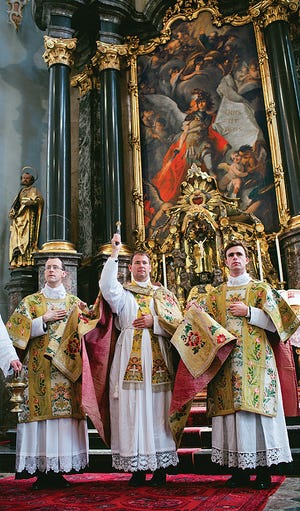
To open the Mass, the priest emerges from his “sacred chamber” dressed in sacred vestments, signifying Christ entering into the world from his dwelling in heaven clothed in holy flesh drawn from the spotless virgin. At a solemn high Mass, first to process is the thurifer, then the crucifer, then acolytes followed by the subdeacon and deacon ahead of the priest. The acolytes if they are carrying candles represent the scribes bringing the light and wisdom of the written word of God to the world. The deacon and subdeacon represent several things. When they are single file ahead of Christ (the priest), they represent the Law and the Prophets of the Old Testament (who preceded Christ). When they are at the sides of the priest, they represent Moses (Law) and Elijah (Prophets) as they stood on either side of Christ during the Transfiguration on Mount Tabor. They also represent the Old (subdeacon) and New (deacon) Testaments. Christ (the priest) is always between them, just as Jesus is the link between the Old and New Testaments; he is the Incarnation and the Old and New Testaments are his Revelation. If there is an assistant priest, such as at a pontifical Mass, he processes ahead of the celebrant to represent John the Baptist, who was the last of the Old Testament prophets and the “Great Forerunner.” The procession signifies a movement toward our home in heaven (which will be shortly opened in the sanctuary during the canon of the Mass). Moses leads the Hebrews out of bondage but he does not reach the Promised Land himself. He dies within sight of it. The entrance procession is therefore Joshua (Jesus) leading the people triumphantly across the Jordan to the Promised Land. The thurifer leading the procession with the incense represents the Shekinah, the presence cloud of God that the Hebrews followed in the desert. The candles represent the pillar of fire. The candle at Mass also has a specific meaning. The flame represents Christ’s divinity, the candle itself signifies his humanity, and the wick symbolizes his soul. Liturgical candles have to contain pure beeswax, since bees who make wax are virgins and of course our Lord received his humanity from a virgin. Candles also represent sacrifice, since for most of history candles were an expensive luxury. Candles also “sacrifice” themselves as they burn and are consumed. That is why in almost every religion candles are part of the ritual to indicate devotion. You should never see oil lamps or torches in a Catholic Church, even for background illumination.When the procession reaches the sanctuary, the part of the Mass that recalls the Old Covenant most vividly — the Asperges, occurs first.
The Mosaic covenant with the Chosen People was sealed by an asperges1 of blood from the animals that were offered at the foot of God’s mountain. The entire people were sprinkled with blood for this one and only time in the history of the Old Covenant. This event is directly linked to the New Testament, where Jesus used the same phrase—”the blood of the covenant”—during the Last Supper to describe His own sacrifice, at the founding meal of the New Covenant. After their aspersion by Moses, the representatives of the Chosen People were led by Yahweh to the Father to share a covenant meal in his presence (Exodus 24:11). Likewise, the New Covenant Asperges now occurs at the foot of the altar — God’s New Covenant mountain. The New Chosen people are led by Yahweh (the in persona Christi priest) to heaven to share a covenant meal with the Father when he opens heaven during the Mass. (The Old and New Covenant meals are discussed in detail here.)
Moses took half the blood and put it in basins, and half the blood he poured on the altar. Then he took the Book of the Covenant and read in the hearing of the people; and they said, “All the Lord said, we will do, and be obedient.” Moses then took the blood, sprinkled it on the people, and said, “This is the blood of the covenant the Lord made with you according to all these words” (Exodus 14:6-8).
Paul explains to the Hebrews why the New Covenant would have to follow a similar pattern to the first. However, the one perfect eternal Sacrifice of Christ fulfills and ends them all.
Therefore not even the first covenant was dedicated without blood. For when Moses had spoken every precept to all the people according to the law, he took the blood of calves and goats, with water, scarlet wool, and hyssop, and sprinkled both the book itself and all the people, saying, “This is the blood of the covenant which God has commanded you.” Then likewise he sprinkled with blood both the tabernacle and all the vessels of the ministry. And according to the law almost all things are purified with blood, and without shedding of blood there is no remission. Therefore it was necessary that the copies of the things in the heavens should be purified with these, but the heavenly things themselves with better sacrifices than these. For Christ has not entered the holy places made with hands, which are copies of the true, but into heaven itself, now to appear in the presence of God for us; not that He should offer Himself often, as the high priest enters the Most Holy Place every year with blood of another—He then would have had to suffer often since the foundation of the world; but now, once at the end of the ages, He has appeared to put away sin by the sacrifice of Himself. And as it is appointed for men to die once, but after this the judgment, so Christ was offered once to bear the sins of many. To those who eagerly wait for Him He will appear a second time, apart from sin, for salvation. (Hebrews 9:18-28).
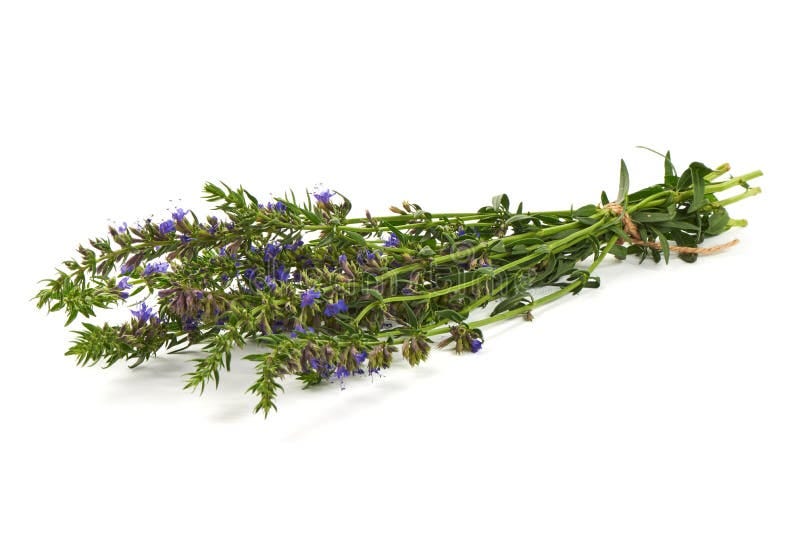
The opening Asperges prayer is taken from Psalm 50 where David implores the Lord to “sprinkle me with hyssop and I will be cleansed; you shall wash me and I will be made whiter than snow” (Psalm 50:9). Hyssop is a wild shrub whose branches were used by the Israelites for purification rituals. David repents of his sins, particularly for arranging for the death of Uriah so that he could lay with his beautiful wife Bathsheba. It is an ancient custom to quote an excerpt from a psalm to draw the listeners’ attention to the entirety of the psalm without having to recite it in full. Looking more deeply, not only does Psalm 50 speak of repentance and purification, it speaks of sacrifice, as in the sacrifice of a “broken and humbled heart” and “a sacrifice of righteousness.” It is only after these sacrifices that God will be pleased with whole burnt offerings on the altar. Burnt offerings are meant to be total offerings. Later in the Mass, the total offering of Christ, both bloody and unbloody, will be re-presented.
Immediately upon arriving in the sanctuary, the priest kneels and sprinkles the altar. This is directly descended from the Old Covenant practice of sprinkling the altar with blood from animals sacrificed during the atonement rites such as on Yom Kippur (Leviticus 16), as well as the daily Tamid offering that maintained the covenant. By sprinkling both the altar (God) and the people with the same blood, the ritual symbolized that God and Israel were now bound together as one “family” in a life-binding agreement. In the Asperges, it is Holy Water, signifying the Holy Spirit that binds us to God,2 not a substitute essence of animal blood. Unlike earlier covenants (i.e., Abraham) which were primarily divine promises, the Mosaic covenant was a bilateral treaty where the blood acted as a formal seal of mutual commitment. The sprinkling of the altar at the Asperges is about renewing the covenant and binding us to God just as Moses did when establishing the Old Covenant. Preparation of the altar of Sacrifice with incense will occur at the offertory rite where it belongs.
The priest then leaves the sanctuary to seal and renew our covenant with God as well as to purify the congregation. This is thematically and functionally similar to the practice of Jews bathing in a mikveh (ritual bath) before entering the Temple. Both rituals serve as physical preparations for entering a sacred space, focusing on cleansing, spiritual renewal, and the transition from the profane to the holy. They also make the congregation worthy to offer itself alongside the Sacrifice which is about to be re-presented.
The only other time hyssop was used to sprinkle blood from Temple sacrifices onto the people was upon individual lepers as part of their purification.
It is important to note that “leprosy” in Hebrew and Greek does not mean what it does today — specifically, Hansen’s disease3. Biblical leprosy, or tzara’at, was a broad, spiritual, and ceremonial term for various skin diseases, mold, or mildew, rather than a specific infection. It was primarily a state of ritual uncleanness. Priests, not physicians, diagnosed leprosy based on Levitical law, focusing as much upon ritual impurity rather than medical pathology.
Now the Lord spoke to Moses, saying, “This shall be the law of the leper for the day of his cleansing: He shall be brought to the priest. The priest shall go out of the camp, and the priest shall examine him; and indeed, if the leprous infection is healed in the leper, the priest shall give orders to take, for the one declared clean, two small birds, live and clean, and also cedar wood, and scarlet, and hyssop. Then the priest must give orders that one of the birds be killed in an earthen vessel over running water. As for the living bird, he shall take it, the cedar wood, the scarlet and hyssop, and dip them and the living bird in the blood of the bird killed over the running water. Then he shall sprinkle the water seven times on the one cleansed from his leprosy, and he shall be clean; then he shall send away the living bird into a field (Leviticus 14:1-7)
Not only is the leper to be sprinkled with blood from the bird sacrifice, the other living bird is to be “sent away into a field” just like the scapegoat carrying away the sin placed upon it (Leviticus 16:22), as was done on Yom Kippur. After this purification, the leper needs to make a series of sin and trespass offerings, including grain and a lamb. Clearly, the “leprosy” here is spiritual as much as physical.4
All three Synoptic Gospels describe instances of Jesus healing lepers (Matthew 8:1–4, Mark 1:40–45, and Luke 5:12–16). In each instance, the healings are associated with the forgiveness of sins.
And He charged him to tell no one, “But go and show yourself to the priest, and make an offering for your cleansing, as a testimony to them, just as Moses commanded” (Luke 5:14).
Jesus doesn’t tell them to present themselves to the Levitical priests just because he respects and follows the Law. As usual, he does this to show that he fulfills and then surpasses the Law. Jesus shows everyone including the priests, that unlike them, he has the divine power to actually heal, not just to diagnose a disease and confirm a cure. He has the power to “heal” someone of the sins that are causing their bodily corruption. This is made explicit after Jesus next heals a paralytic.
When He saw their faith, He said to him, “Man, your sins are forgiven you.” And the scribes and the Pharisees began to reason, saying, “Who is this who speaks blasphemies? Who can forgive sins but God alone?” But when Jesus perceived their thoughts, He answered and said to them, “Why are you reasoning in your hearts? “Which is easier, to say, ‘Your sins are forgiven you,’ or to say, ‘Rise up and walk’? “But that you may know that the Son of Man has power on earth to forgive sins”—He said to the man who was paralyzed, “I say to you, arise, take up your bed, and go to your house (Luke 5:20-24).
Jesus makes the point that anyone can say that someone’s sins are forgiven because there is no immediate way to tell, though with a physical healing, there is no denying when a man can now rise up and walk. Church Fathers understood this and linked the healing of spiritual leprosy to the Sacraments of Baptism and Confession. As St. John Chrysostom writes,
The Jewish priests had authority to release the body from leprosy, or, rather, not to release it but only to examine those who were already released, and you know how much the office of priest was contended for at that time. But our priests have received authority to deal, not with bodily leprosy, but spiritual uncleanness — not to pronounce it removed after examination, but actually and absolutely to take it away.5
Each part of the Mass re-presents an aspect of the life of Christ. In this very first part, we are seeing the Yahweh of the Old Testament. The Asperges reminds us of the sprinkling of blood with the hyssop branches of the Old Testament in order to purify us of our sins. He does this to atone and make reparation for the High Priest Aaron who made the Golden Calf. It is because of this betrayal that Yahweh institutes the hereditary priesthood and the restrictive Mosaic Law. Of course, the restrictive Mosaic Law is superseded by Jesus and the law of Love, though Rabbinic Jews insist upon struggling under the punitive Mosaic Law to this very day. The High Priest of the New Covenant, the in persona Christi Catholic priest, does the same thing with an aspergillum and holy water to represent and fulfill what was done in the Old Testament with hyssop and the blood of an animal. It is only the Aaronic High Priest who sprinkled and purified the people; therefore, it is only the priest who does this in the Mass, not the deacon or any other functionary. The Mass is the continuation and fulfillment of the Mosaic sacrificial system with the re-presentation of the Passion of Christ; therefore, it is only fitting that it should begin with a remembrance of the event that caused the Old Testament priesthood and sacrificial system to be instituted in the first place. The Sacrifice of the Traditional Mass therefore begins at the beginning. But it is more than that. The Day of Atonement is a prefigurement of the Passion and the eternal offering of the Sacrifice of Christ the High Priest to the Father in heaven. On the Day of Atonement, the High Priest enters into the Holy of Holies carrying his blood sacrifice on behalf of the people, just as the Catholic in persona Christi priest does in the Mass when he enters into the Holy of Holies as the offeror and the offering during the Canon bearing the bloody and unbloody Sacrifice with whom the Father “is well pleased.”
How exactly is this atonement accomplished? During the Easter season, in particular, the Asperges rite gives us a preview of the Sacrifice on the Cross that will be re-presented shortly in the Canon of the Mass itself with the singing of the Vidi aquam.
And I saw water flowing from the right side of the temple, alleluia; and all to whom that water came were saved, and they shall say: alleluia, alleluia.6
In the Old Covenant, blood and water from the sacrifices flowed from the right side of the Jerusalem Temple into the Kidron River. In the New Covenant, “living water” flows from the eternal Temple, the wounded right side of Christ. The purification by blood and hyssop branches in the Old is a symbol of the true purification that comes from the blood of Christ in the New. The pouring out of Christ’s blood occurs during the Passion. That is why during the Easter liturgical season, we sing of the blood and water flowing from the right side of the eternal Temple, which is the fulfillment of the blood and water flowing out of the side of the Jerusalem Temple.
The Mass brings together both the Old and the New Testaments and fulfills them both. Sprinkling the people with water is also a reminder of baptism. At the Asperges, which is at the beginning of our salvation journey in the Mass, this is not yet a baptism of the Spirit, however, but a baptism of repentance. The cure for our spiritual leprosy is begun by baptism and is foreshadowed by the story of the Syrian general Naaman.
So Naaman went down and dipped seven times in the Jordan, according to Elisha’s instruction, and his flesh was restored like the flesh of a little child, and he was cleansed. Then he, with all his aides, returned to Elisha and came and stood before him; and he said, “Indeed, now I have come to know that in all the earth there is no God except the God of Israel” (2 Kings 5:14-15).
Notice that Naaman was baptized in the Jordan, where Jesus himself later submitted to John’s baptism of repentance and opened heaven. Baptism in the Jordan is not yet a baptism of the Spirit which is yet to come at Pentecost with the completion of the ordination of the New Covenant priests, but a fitting and necessary preparation, just as the Asperges rite itself is. However, it is also a story of humility as Naaman is resentful that the healing did not occur the way he expected until he accepted that salvation came from the Promised Land of Israel and the Jewish God — whom he had previously looked down upon.
The baptism of repentance in the Jordan is in preparation for the atoning Sacrifice that is to be re-presented in the Canon. It is the baptism of repentance preached by John “to prepare the way for the one who is to follow.” To underscore this, the priest is accompanied by the deacon, who represents the New Testament, and the subdeacon, who represents the Old Testament, as he sprinkles the people.
Of course, images of copious amounts of water signifying Grace flowing from the Temple are common in Scripture. A particularly appropriate image for our discussion is found in Ezekiel. He has a vision of water flowing from the Jerusalem Temple that actually increases the further it flows from its source.
Again he measured a thousand (cubits) and he passed through the water, and the water was up to the knees. Again he measured a thousand, and water came up the waist. Again he measured a thousand, and it could not be crossed; for it broke into a rushing torrent which man cannot pass through (Ezekiel 47:4-5).
There is life in and near these waters, but outside of it, there is death. Of course, the temple is an image of Jesus who is the true temple and the blood and water are flowing from his lanced side as he hangs on the Cross. The blood and water flowing from his side also identifies him as the New Adam, from whom his bride the Church would come. From the very first, the traditional rite sets the stage and provides the context for the salvation drama that is re-presented in every Mass.

For the benefit of dead language nerds — in Latin, the word asperges means “thou wilt sprinkle“ or “you will sprinkle.“ It is the second-person singular future indicative form of the verb aspergere (to sprinkle or scatter).
Just as in the sacrament of baptism.
Hansen’s disease, commonly known as leprosy, is a chronic infectious disease caused by slow-growing Mycobacterium leprae bacteria. Since the 1940s, it has become eminently curable by antibiotics.
Not only the body needs to be purified of spiritual leprosy, but even the houses in the promised land of Canaan have to be purified of leprosy (mold) (Leviticus 14:33-57). The procedure is very similar to the purification of the body, including the sprinkling with the blood of a bird, while the second bird is released into a field to carry away the corruption.
Mold, as a saprophyte, is a sign of corruption which is the result of sin, hence the extremely strict prohibition against leavened bread for any ritual purpose, including today as valid matter for the Eucharist. Even more intriguingly, leavened bread is associated with Egypt. When the Isrealites were longing for the fleshpots of Egypt, they weren’t longing just for the meals, but for paganism. Fascinatingly, leprosy as a disease seems to have originated in ancient Egypt and was spread by the waters of the Nile. From there, it slowly made its way around the world.
Just as there is an association between Egyptian paganism and leavened bread, there is a connection between spiritual and physical leprosy.
St. John Chrysostom, On the Priesthood (Book III.6), accessed March 7, 2026, https://www.newadvent.org/fathers/19223.htm.
Dom Gaspar Lefebvre, The Saint Andrew Daily Missal (Great Falls, MT: St Bonaventure Publications, 1999), 951.